
Key Words: Silicon Wafer Dicing PCB Depaneling Glass Cutting
Home > News > Industry News
【Description】:
A comprehensive technical side-by-side comparison between mechanical punching and UV laser drilling for LTCC green tape via formation, evaluating via size limits, edge quality, speed, tool wear, and total cost of ownership.
In the production of multilayer LTCC substrates, via formation is one of the most critical and cost‑determining steps. Vias—tiny vertical interconnections that link conductor layers—must be created with precision, consistency, and speed to meet the demands of modern high‑density designs. Two primary technologies dominate the field: mechanical punching (using a punch‑and‑die set) and laser drilling (using focused laser energy). Each has a long history in LTCC manufacturing, but as via diameters shrink and production volumes rise, the choice between them has become increasingly consequential. This article provides a comprehensive, side‑by‑side comparison of these two via‑forming methods across five critical dimensions: quality, speed, tool wear, via size limits, and cost.
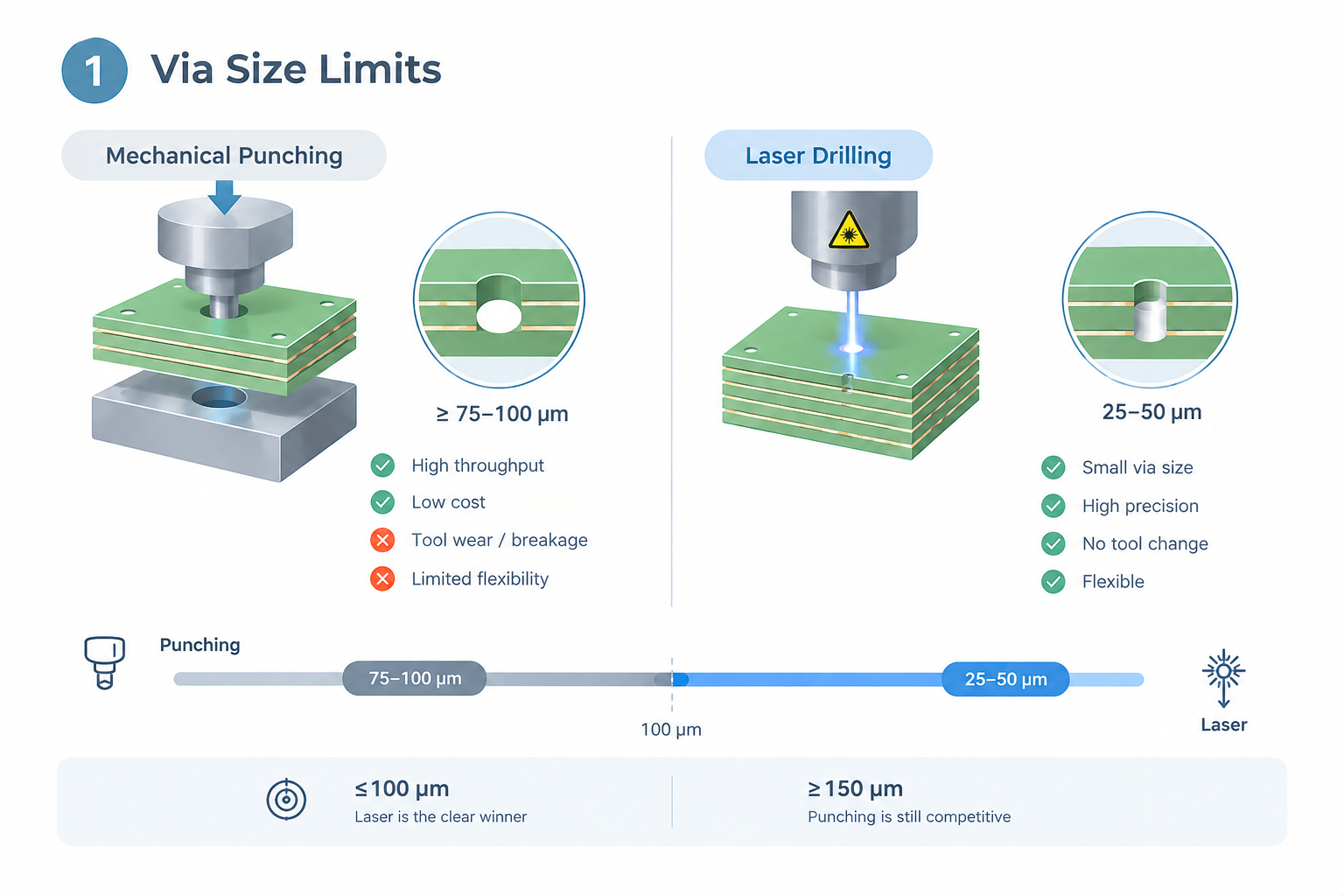
The minimum achievable via diameter is often the first specification that determines which technology is viable for a given application.
Mechanical Punching: Conventional punch‑and‑die sets can reliably produce vias down to approximately 75–100 μm in diameter. Below this threshold, punch breakage becomes frequent, and die alignment tolerances become prohibitively tight. For high‑volume production, many manufacturers consider 100 μm as the practical lower limit. While custom micro‑punches have been demonstrated down to 50 μm, they suffer from extremely short tool life and are rarely used in commercial production.
Laser Drilling: Laser systems, particularly those operating at 355 nm (UV wavelength), can achieve via diameters as small as 25–50 μm with excellent reproducibility. For advanced LTCC applications—such as 5G RF modules, antenna‑in‑package (AiP), and high‑density interposers—laser drilling is often the only viable method. Moreover, lasers can easily accommodate different via sizes within the same production run without tool changes, offering unmatched flexibility.
For via diameters ≤100 μm, laser drilling is the clear winner. For larger vias (≥150 μm), mechanical punching remains competitive but is increasingly replaced by laser drilling as designs trend towards finer features.
Via quality directly affects electrical reliability, mechanical strength, and subsequent metallisation adhesion.
Mechanical Punching: When properly maintained, mechanical punching produces clean, sharp edges with minimal delamination. The hole walls are mechanically sheared, resulting in a smooth surface that is well‑suited for via filling. However, as the punch diameter decreases and the tape thickness increases, edge tearing and burr formation become more common. Additionally, the mechanical stress from punching can cause micro‑cracking in the green tape, which may propagate during lamination and co‑firing, leading to latent reliability issues.
Laser Drilling: UV laser ablation removes material photochemically, producing a clean hole with minimal mechanical stress. The primary quality concern is the heat‑affected zone (HAZ)—a region of thermal damage surrounding the hole. With optimised parameters, nanosecond UV lasers can limit the HAZ to 10–20 μm, while picosecond lasers can achieve <5 μm. In well‑controlled processes, the HAZ is barely visible under optical microscopy, and the hole edge exhibits good surface finish with negligible recast or debris. For post‑lamination drilling, laser drilling preserves the registration between layers, as it does not impose lateral forces that could shift the stack.
Laser drilling offers superior edge quality for small vias, with minimal mechanical damage. For large vias (>150 μm) in thick tapes, punching may produce comparable quality at lower cost, but the risk of micro‑cracking remains a concern.
| Quality Aspect | Mechanical Punching | Laser Drilling (UV) |
|---|---|---|
| Edge roughness | Smooth (shear) | Smooth (ablative) |
| Delamination risk | Moderate (small dies) | Very low |
| Micro‑crack risk | Moderate to high | Negligible |
| HAZ | None | 5–20 μm (nanosecond) / <5 μm (picosecond) |
Mechanical Punching: Punching is inherently a batch process. A single stroke can produce multiple vias simultaneously if a multi‑punch tool is used, but each tool is dedicated to a specific via array. Cycle times are typically 0.5–2 seconds per stroke, depending on the tape thickness and the number of punches. For large panels with thousands of vias, punching can be faster than scanning each via individually with a laser—but this advantage diminishes as via patterns become more complex and non‑uniform.
Laser Drilling: Laser drilling is a serial process—each via is drilled sequentially by scanning the beam. However, modern galvanometer scanners can achieve speeds of 800–1200 mm/s, drilling hundreds of vias per second. For example, at a repetition rate of 200 kHz and with appropriate pulse overlap, a UV laser can drill over 200 vias per second for typical 100 μm diameter holes. The total time for a panel is thus determined by the number of vias and the scanning strategy. For high‑density designs with thousands of vias, laser drilling can be competitive with punching, especially when considering the time saved from tool changes and alignment.
For simple, uniform via arrays (large vias), mechanical punching may be faster. For complex, non‑uniform via patterns (small vias), laser drilling often has higher overall throughput due to the absence of tool‑change downtime and the ability to drill vias of different sizes in a single pass.
Mechanical Punching: The tooling—punches and dies—is subject to constant wear. Each punch has a finite lifetime, typically 50,000–200,000 strokes before it requires sharpening or replacement, depending on the tape material and the punch diameter. Smaller punches wear faster due to higher stress per unit area. Tool replacement costs can be significant, especially when multiple punch sizes are used. Additionally, tool changes require machine downtime and skilled setup, adding to labour costs.
Laser Drilling: Lasers have no physical contact with the workpiece, so there is no tool wear. The laser source itself has a defined lifetime (typically 20,000–40,000 hours for solid‑state UV lasers), but this is a gradual degradation, not a sudden failure. Consumables are minimal—primarily the laser gas (if used) and replacement optics (e.g., protective windows), which have long service intervals. The cost per via decreases as the laser is utilised over its lifetime, making it very attractive for high‑volume, long‑run production.
The total cost of ownership (TCO) for each method must consider both initial investment and ongoing costs.
| Cost Component | Mechanical Punching | Laser Drilling |
|---|---|---|
| Equipment cost | Lower (punch press and tooling) | Higher (laser system, scanner, motion stage) |
| Tooling cost | High (punches and dies, regular replacement) | None (no contact tools) |
| Maintenance cost | Moderate (punch sharpening, die alignment) | Moderate (laser optics cleaning, power calibration) |
| Floor space | Small | Moderate (laser cabinet, chiller) |
| Flexibility | Low (tool changes for different vias) | High (parameter‑based changes) |
| Labour cost | Higher (tool changeovers, setup) | Lower (program‑based operation) |
| Cost per via (high volume) | Low to moderate (but rises with smaller dies) | Declines with volume; very low for fine vias |
For via diameters >150 μm and simple arrays, punching has a lower TCO. For via diameters <100 μm, complex patterns, or high‑mix production, laser drilling becomes cost‑competitive—and often superior—due to the elimination of tooling costs and the flexibility to handle multiple designs without downtime.
The LTCC industry has witnessed a clear trend: as via diameters shrink and layer counts rise, laser drilling is increasingly replacing mechanical punching. This shift is driven by:
Design requirements: 5G and automotive radar demand via sizes below 100 μm, which punching cannot reliably achieve.
Yield improvement: Laser drilling reduces delamination and micro‑cracking, improving overall yield, especially for thin tapes.
Flexibility: Laser systems can be reprogrammed in minutes, supporting rapid design iterations—a critical advantage in today's fast‑paced electronics development cycles.
While mechanical punching will likely retain a role for coarse, high‑volume applications, UV laser drilling has become the enabling technology for advanced LTCC substrate manufacturing. Its ability to produce clean, precise vias down to 25 μm with minimal thermal and mechanical damage makes it indispensable for next‑generation microelectronics.
Chanxan Laser offers a comprehensive range of UV nanosecond and picosecond laser systems purpose‑built for LTCC green tape via drilling. Our solutions are engineered to overcome the limitations of mechanical punching and deliver the precision, reliability, and throughput that modern LTCC production demands.
High‑precision drilling: Achieve consistent via diameters from 25 μm upwards, with positional accuracy of ±20 μm and HAZ controlled to <20 μm (nanosecond) or <5 μm (picosecond).
Flexible processing: Support both pre‑lamination (single‑layer) and post‑lamination (multilayer stack) drilling, adapting to your existing workflow.
Optimised parameters: Our application engineers work with your specific LTCC tape formulation to define the ideal pulse energy, repetition rate, scanning speed, and focal position—ensuring clean, burr‑free vias with zero thermal damage.
High‑throughput automation: Integrated motion stages with ±2 μm repeatability and scanning speeds up to 3000 mm/s enable cost‑effective mass production, even for panels with tens of thousands of vias.
Proven reliability: With solid‑state laser sources offering 20,000+ hours of operational life and minimal consumables, our systems deliver a lower total cost of ownership than mechanical punching for fine‑via applications.
Contact Chanxan Laser today for a sample drilling trial or to consult with our application engineers about your specific green tape requirements.
Request a Sample Trial & Quote| Free solution
Previous: UV Nanosecond vs. Picosecond Laser for LTCC Green Tape Micromachining
Next: Lamination and Via Formation: Building Multilayer LTCC Structures